Content
Two 120 W evaporative coolers can look identical on the carton, yet behave completely differently in the same 40 m² workshop: one pushes a visible, measurable breeze across the benches, the other only stirs air around its own blades. The figure that separates them is not the wattage printed on the box, but how much air each unit delivers for every watt it draws — and how well it holds that ratio through a season of dust, heat and daily start-ups.
Short version: a genuinely energy efficient fan moves the airflow you need at the lowest input power, at the static pressure your installation actually creates, and keeps that performance with basic maintenance. What follows explains how to verify the claim with numbers, where the watts are lost, and which specifications to demand before you place an order.
The calculation is simple: delivered airflow divided by input power. A unit moving 5,000 m³/h at 120 W returns about 42 m³/h per watt. The same fan and blade set restricted to 3,000 m³/h returns 25. Both cartons can honestly say "low energy consumption", yet only the ratio tells you which one will cool the far corner of the room and which one will keep the electricity meter turning for a weaker result.
Rated airflow is measured with free discharge. The moment a unit pushes through a grille, a duct stub, a half-open window frame or a wet pad loaded with mineral scale, static pressure rises and delivered airflow falls — commonly by 15–30% in a careless installation. Ask suppliers for airflow at a stated static pressure, and for power draw at each speed setting rather than one headline rating.
Motor choice matters as much as blade design. Shaded-pole AC motors are inexpensive and common in budget coolers; brushless DC (BLDC) designs cost more but convert a much larger share of input into shaft work, so a 40–50 W DC fan can deliver airflow that needs 70–90 W from an AC equivalent. In larger three-phase equipment, ecodesign rules such as Regulation (EU) 2019/1781 push motors towards defined IE efficiency classes — useful leverage when you are specifying a project batch.
| Label figure | What it confirms | What it hides |
|---|---|---|
| Rated power (W) | Electrical draw at one operating point | Whether that draw applies to every speed or only to maximum |
| Maximum airflow (m³/h) | Free-air output of the fan assembly | Output at the static pressure of your real installation |
| Motor type and class | Shaded-pole, PSC or BLDC; IE class for three-phase units | Duty cycle and heat rise in a 40 °C room |
| Noise figure (dB) | Sound level at the stated speed and distance | How quickly it climbs once the pad starts scaling |
| Tank capacity (L) | Run time between refills | Pump power and standby draw of remote or voice electronics |
Efficiency losses in a cooling fan appear in predictable places. Recording them on a service sheet makes it much easier to compare two quotations line by line.
Before comparing motors, compare the duty. A fan correctly sized to the heat load can run on a lower speed for the same comfort; an oversized unit is usually run flat out to compensate for poor placement, and an undersized one never catches up at all.
Sizing rule of thumb: designers commonly work at roughly 20–30 air changes per hour for workshops and 10–15 for homes, with a door or window cracked open as the exhaust path. If a supplier quotes a room area in square metres without asking about heat load, ceiling height and air exchange, that recommendation is a guess.
Specifications only become convincing when they map onto real products. These three examples show the same efficiency logic at different scales — a compact DC floor fan, a mid-size household cooler and a large industrial cooler.
A DC air circulation fan with low input power, quiet running and voice control. It suits a room that is already cooled, where the job is breaking up stratified air rather than cooling a space from scratch.
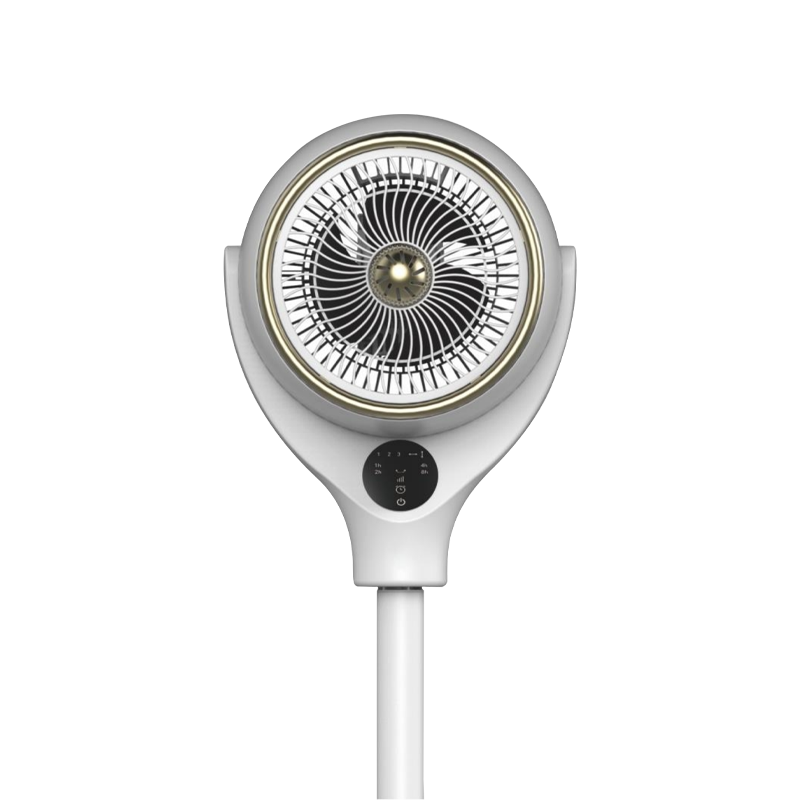 Fan-03 Voice-Controlled Silent Floor FanA 25W floor fan with voice and remote control, 90° horizontal and vertical oscillation, and a stable base for hands-free indoor air circulation.View Product →
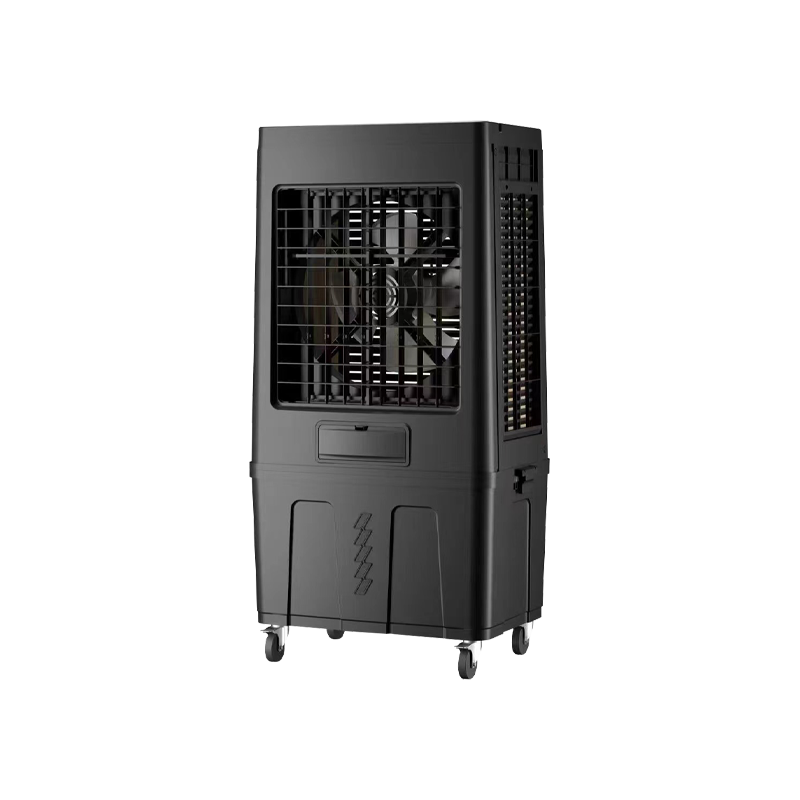
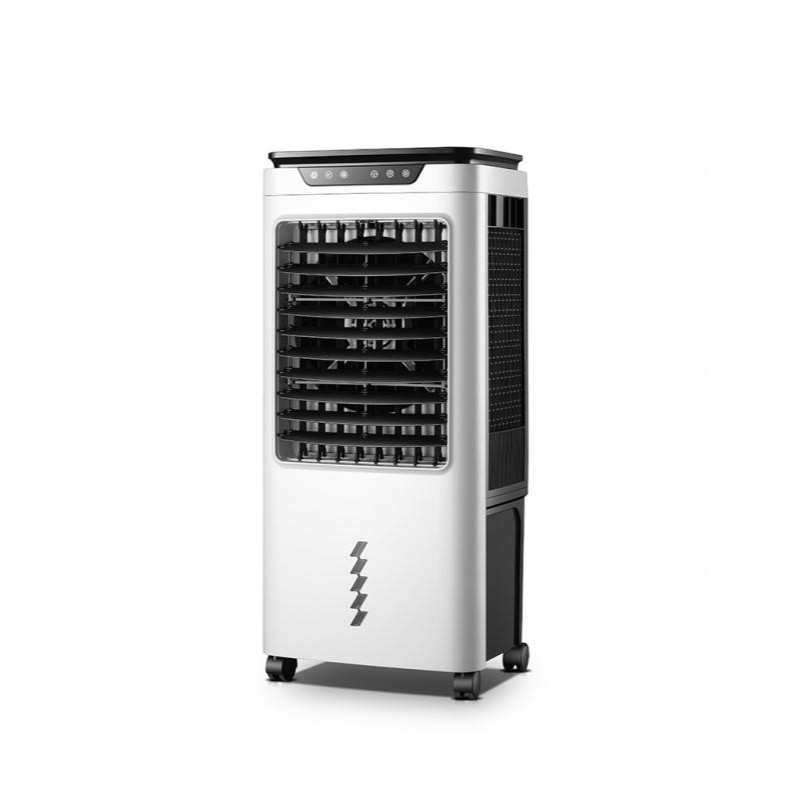
A large tank stretches the interval between refills and keeps the pump cycling less often, while the low-energy positioning targets long daily duty in homes, shops and small workshops.
 LBW-13000RC Low-Energy Floor Air CoolerA 180W evaporative cooler with 75L/95L tank options, 8000 m³/h airflow and remote or body controls for 40–70 m² spaces.View Product →
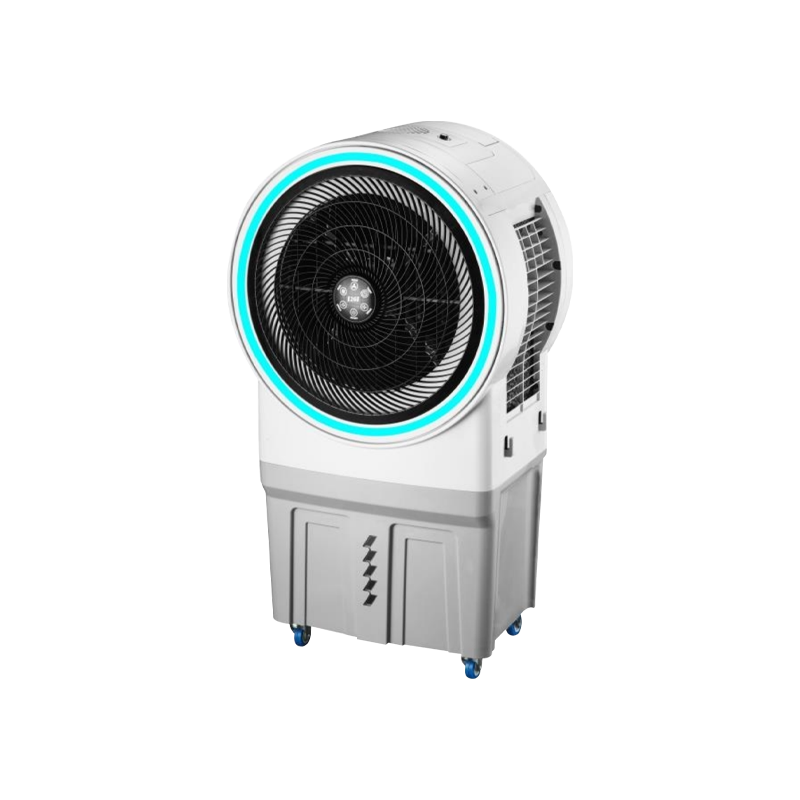
Industrial sizing where airflow, not cooling capacity on paper, is the real constraint: high air volume at a controlled noise level, so the unit can run a full shift without dominating the hall.
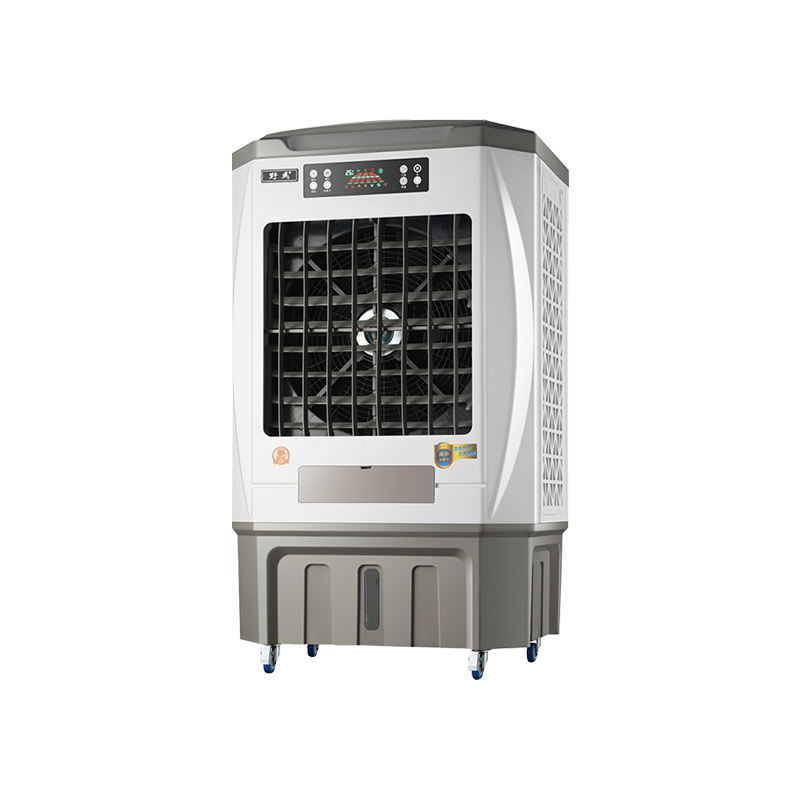 LBW-16000RC Industrial Evaporative Air CoolerA 400W industrial cooler with 12,000 m³/h airflow, 80L tank, triple-curtain filtration and remote control for 80–120 m² spaces.View Product →
Take a 120 W evaporative cooler with a 15 W pump, 8 hours a day for a 120-day season at $0.20 per kWh. The unit uses about 130 kWh, or roughly $26. The same comfort hours from a 2 kW portable air conditioner cost about $384. A 45 W DC circulation fan, used to make an existing air conditioner work less, lands near 43 kWh — about $9.
| Configuration | Power draw | Seasonal energy | Seasonal cost |
|---|---|---|---|
| Evaporative cooler, 120 W fan + 15 W pump | 135 W | ≈ 130 kWh | ≈ $26 |
| DC circulation floor fan, 45 W | 45 W | ≈ 43 kWh | ≈ $9 |
| AC table fan, 60 W | 60 W | ≈ 58 kWh | ≈ $12 |
| Portable air conditioner, 2.0 kW | 2,000 W | ≈ 1,920 kWh | ≈ $384 |
The cheapest unit does not win on the invoice alone. The gap between a well-matched fan and a badly matched one is a season-long running cost that usually overtakes the purchase price difference within two to three years, and the gap widens quickly wherever duty cycles run long.
Field performance drifts. A unit that measured well in the test room can lose a fifth of its airflow within a season if the pad, tank and guards are neglected.
When the order is a container rather than a single unit, the questions change from features to verifiable data. Six items cover most of the risk.
For an overview of models and capacities, the full cooling fan range runs from 15 L portable units to 260 L floor-standing tanks, which is broad enough to match a fan to a heat load instead of forcing a heat load into one model. Buyers weighing the wider category shift can also read why evaporative cooling is being adopted as a lower-energy alternative in commercial spaces.
The practical conclusion is refreshingly plain: ask for airflow and power at each speed, size the unit to the heat load rather than the floor area, install it so it can exhaust, and keep the pad and grilles clean. Those four steps shape the electricity bill far more than any single feature on the carton — and they are exactly what separates a fan described as energy efficient from one that measurably is.


No.1015 Guanfu Road, Fuhai Town, Cixi City,Zhejiang,China

+86 134-8601-6220



Copyright ? Cixi Bisheng Electrical Appliance Co., Ltd. All Rights Reserved.
Wholesale Portable Air Cooler Manufacturer




 English
 中文简体
 Español